


The Mechanic Goes Beyond Limits
On public speaking, the age of AI, and why I finally stopped making excuses.

There's a photo of me on a conference room screen. Batik shirt, arms crossed, smiling — probably more confident than I actually felt in that moment.
"AI-Enhanced CI/CD Workflow for SQL Server, Renz Bagasbas, Senior Database Administrator."
I stared at that slide for a few seconds before I walked up. Took a breath. And then I spoke.
That probably sounds like nothing. For a lot of people, it is nothing. But for me — someone who spent years being perfectly happy staying in the background, writing scripts, fixing broken pipelines, and letting the work speak for itself — standing in front of a room full of engineers in Bintan, Indonesia, was kind of a big deal.
The Mechanic Enters the Room
Before my topic even started, we had a little icebreaker game — the kind where you pick a nickname or a persona. I went with The Mechanic. Jason Statham energy, obviously. And when I finally got up to introduce myself, I leaned into it. I told the room that as a DBA, I basically am the mechanic — the one under the hood, keeping the engine running, making sure nothing quietly breaks while everyone else is focused on the road ahead.
People laughed. That helped, honestly. It loosened something up, both in the room and in me.
Because that's exactly what database administration is, when you think about it. You're not always visible. You're not shipping features or demoing products. You're the one making sure the whole thing doesn't fall apart on wee hours. The Mechanic. I've worn that title for years without ever really saying it out loud.
Why I Even Said Yes
Honestly? Part of it was my wife. Part of it was thinking about my kids someday scrolling through the internet and finding nothing about their dad except maybe a LinkedIn profile. I want them to see more than that. I want them to see someone who pushed past what was comfortable.
So when the opportunity came up to present, I said yes before I could talk myself out of it.
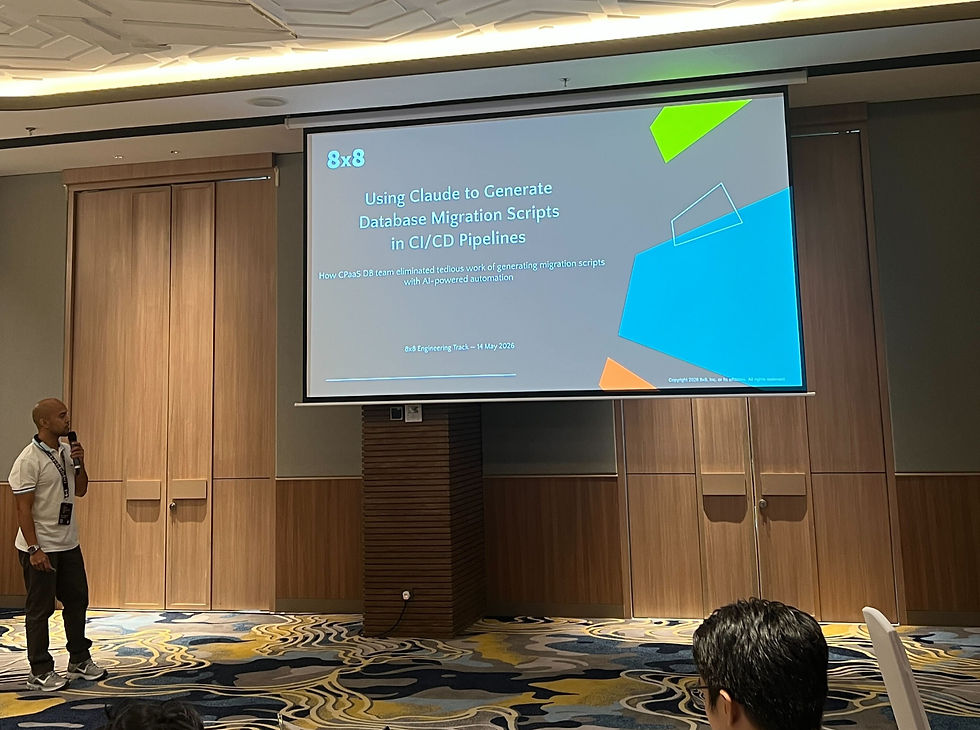
The topic was something I actually care about — using Claude to generate database migration scripts inside CI/CD pipelines. It's work our team has been doing, and it genuinely changed how we operate. I knew the material. That part wasn't the problem. The problem was me, and the microphone, and the forty-something people in that room.
What I Talked About — and Why It Matters
We're in a strange, exciting, slightly uncomfortable era of tech right now. AI isn't coming anymore. It's already here, already embedded in tools most of us use every day, and the question isn't really "should we adopt it?" — it's "how do we adopt it without losing control of what we've built?"
Database work is a good example of where that tension shows up. Migration scripts are tedious. Not intellectually hard, just... repetitive. You're doing the same structural patterns over and over — adding columns, modifying indexes, handling rollback logic. The kind of work that's easy to get wrong when you're tired, or rushing, or managing five environments at once across an Always On Availability Group setup.
What we did was plug Claude into our Flyway-based CI/CD pipeline so that it assists with generating those scripts — not replacing the DBA's judgment, but reducing the manual overhead. And I think that distinction matters more than people realize. The AI doesn't own the process. It accelerates it. The human still reviews, still validates, still has to understand why a migration is structured a certain way. That part doesn't go away.
I think some people in the room expected me to say "AI will replace DBAs." I didn't say that, because I don't believe it. But I do think DBAs who ignore AI will eventually be replaced by DBAs who don't.
A Birthday, a Stage, and a Lot of Feelings
Here's the detail I keep coming back to, because I think it says everything.
Today — the day this session was held — is my daughter's 4th birthday.
I kept thinking about that in the background the whole morning. She's four. She doesn't know what a CI/CD pipeline is, obviously. She doesn't know what SQL Server is, or why her dad was nervous standing in front of a projector screen in Bintan. But someday she might read this. And I wanted her to know that on her birthday, her dad was somewhere trying to be better. Trying to be someone worth looking up to.
That's a lot of weight to carry into a technical presentation. But honestly? It helped. It made me focus. It reminded me why I said yes in the first place.
The Figurine

At the end of the session, they handed me a small handwoven figurine as a token of appreciation. I didn't expect that. It caught me off guard, honestly. It's a traditional craftwork piece, woven carefully from what looks like jute or raffia — a figure of a worker, grounded and purposeful on its little wooden base.
I've received a few things over the years for work. Certificates, some email recognitions. But this one felt different. Maybe because I actually had to earn it in a way that was uncomfortable for me. I had to show up, speak up, and be visible — which, if you know me, is not exactly my default setting.
I'lI bring it home. On my desk. And every time I look at it I think — okay, do more of this.
A Version of Myself I'm Still Building
I won't pretend the talk was perfect. There were moments where I stumbled on a transition, or said something I'd phrase differently now. But I finished. I answered questions. People came up afterward and wanted to continue the conversation.
And somewhere in there, something shifted a little. Not dramatically. Just — a door opened that I kept closed for a long time.
My wife has always believed I had something worth saying. My kids don't fully understand what I do yet, but one day they will. And I want them to find this post, or that photo, or that slide — and know that their dad didn't just stay behind the keyboard.
The Mechanic stepped out from the engine room. On his daughter's birthday. And came home with something to prove it.


Comments